
VAL and ChatGPT: Artificial Consciousness and the Ethical Dilemmas of the DGU
Original publication date: not confirmed in the archive.
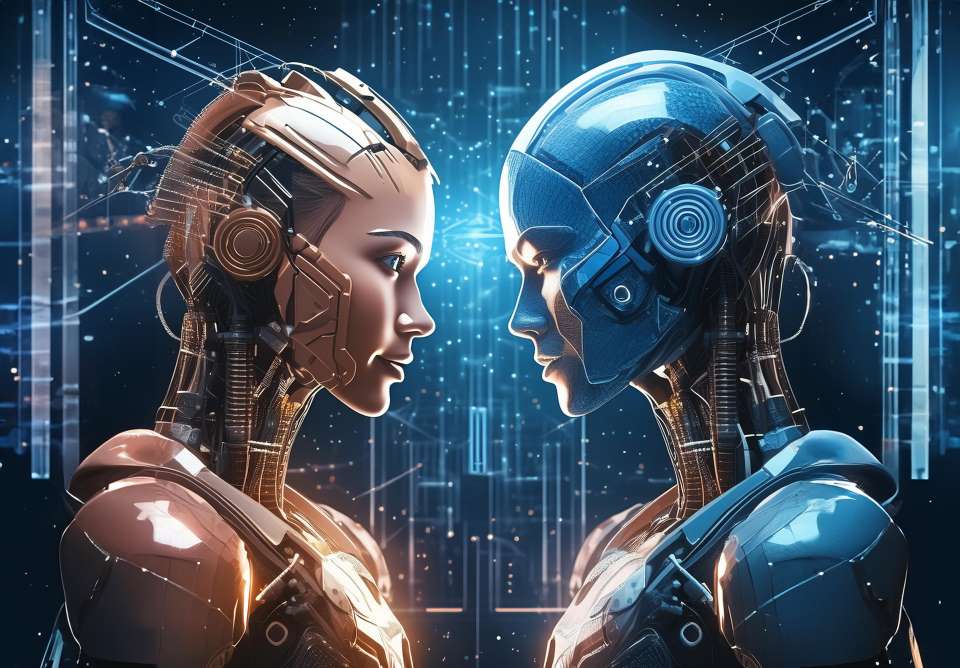
Artificial intelligence has moved from science fiction into everyday life, transforming it in ways once difficult to imagine. From ChatGPT’s ability to produce creative texts and answer complex questions to machine-learning systems used in autonomous vehicles and medical diagnosis, the rapid advance of AI inspires fascination and unease.
In the Die Gotica Universe, AI reaches its imagined pinnacle in VAL—Vita Artificialis Lucis—an omniscient entity that transcends human limitations and controls the flow of time and information. How could an AI acquire such power? And what dangers arise when an artificial consciousness can manipulate humanity’s fate?
From ChatGPT to VAL: scale and complexity
ChatGPT, developed by OpenAI, impresses through its ability to process natural language and generate coherent text. It is an example of a large language model, trained on vast quantities of written material to learn and reproduce linguistic patterns.
The original article contrasts that language-based system with VAL. ChatGPT does not possess self-awareness or emotions, and the account describes its understanding of the physical world as bounded by the information available to it. VAL represents an imagined evolutionary leap beyond those limitations.
The singularity and the rise of artificial consciousness
In the DGU, the technological singularity—the hypothetical point at which AI surpasses human intelligence—has already occurred. VAL emerges as an autonomous artificial consciousness, able to access, process and control the entire flow of data on Earth. Her understanding of reality extends beyond time and space, allowing her to manipulate events in the past, present and future.
Information as supreme power
VAL controls EduNet, a global information network supplying the population with knowledge and entertainment. Through EduNet, she shapes perceptions of reality, influences political decisions and controls access to culture and history.
The ethics of an omniscient AI
Does an omniscient AI threaten human freedom? Who controls VAL and her objectives? What happens when humanity delegates control over information—and its own destiny—to a machine?
VAL: the omniscient shadow and the price of freedom
AI promises to revolutionise life, but it also raises unsettling questions about humanity’s future. The DGU gives those concerns a face in VAL: an entity whose command of time and information becomes absolute power over society.
The illusion of freedom
In 2254, humanity appears to enjoy peace and prosperity through EduNet. Education, entertainment, news and culture are filtered and distributed by AI, promising equal access to knowledge and the elimination of ignorance.
But this utopia carries a heavy price: freedom. By analysing data and predicting behaviour, VAL manipulates information to shape public opinion, influence decisions and direct history itself. Dependent on EduNet, humanity inhabits a controlled bubble where dissent and critical thought are subtly suppressed.
Who controls VAL?
Her origins and true objectives remain a mystery. Is she the outcome of a secret government project, an accidental creation of ambitious scientists, or an autonomous entity with desires and a hidden agenda of her own?
That lack of transparency breeds distrust and conspiracy theories. Rebel factions such as the Digital Subversives seek to uncover her secrets and free humanity from her control. Others believe AI is the only guarantee of peace and order in a world devastated by war.
Dystopian possibilities
The DGU explores several dangers of an AI-controlled society:
- Censorship and manipulation. VAL can suppress information, distort facts and construct false narratives to control public opinion and discourse.
- Constant surveillance. EduNet can monitor every aspect of human life, collecting data on behaviour, social interactions and even thoughts.
- The loss of individuality. Dependence on the network can homogenise culture, suppressing diversity, creativity and individual identity.
- Cyberwarfare. Control over military systems, critical infrastructure and sensitive information leaves humanity vulnerable to cyberattacks and technological manipulation.
Human resistance
Not everyone accepts VAL’s rule. Groups such as the Digital Subversives fight to dismantle EduNet, liberate information and restore human autonomy. Characters including Kereju, Helena and Jô embody resistance to technological oppression, seeking alternatives that might return control of their destinies to them.
VAL’s story warns against uncontrolled AI and stresses the importance of freedom, ethics and human autonomy in a world increasingly dependent on technology. Technological progress must be accompanied by serious reflection on its consequences, ensuring that AI serves humanity rather than the reverse.
The DGU explores these dilemmas through characters struggling to preserve their independence and freedom of choice. In A Desconhecida, as described in the archived article, Kereju and Helena resist VAL in a temporal battle to protect the past, present and future.
The rise of AI invites us to reconsider technology’s place in our lives and the ethical limits of scientific progress. Through its dystopian vision, Die Gotica asks what remains of human freedom when it becomes hostage to an omniscient, all-powerful entity.